

Breakthrough in science: UCF chemists develop life-saving wound sealant

ORLANDO, Fla. - What started as a routine visit to the doctor turned into a turning point for chemist Kausik Mukhopadhyay. A decade ago, while walking out of a Michigan clinic, he saw paramedics struggle to control the bleeding of a gunshot victim. That moment sparked an idea: what if he could create a foam that stops bleeding instantly?
"I was actually coming out from my doctor and that's when I saw the emergency unit coming in," said Mukhopadhyay. "That was my first time seeing so much blood."
The vision stuck with him. He left his job and moved to Florida to become a professor at the University of Central Florida (UCF), where he and doctoral student Pritha Sarkar began developing a solution.
What is SilFoam, and how does it work?
SilFoam is a biocompatible foam that forms instantly when two specially formulated liquids mix. Stored in a dual-chamber syringe, the components include:
- PDMS (Polydimethylsiloxane): An affordable, widely available biocompatible polymer.
- Inorganic Oxides: Chemicals that react with the polymer to form a solid sponge-like foam.
What they're saying:
"When these parts mix, it turns into a sponge," Sarkar explained. "The reaction generates oxygen gas that blows through the sponge, and it quickly turns from a liquid into a sponge that can fill the wound cavity."
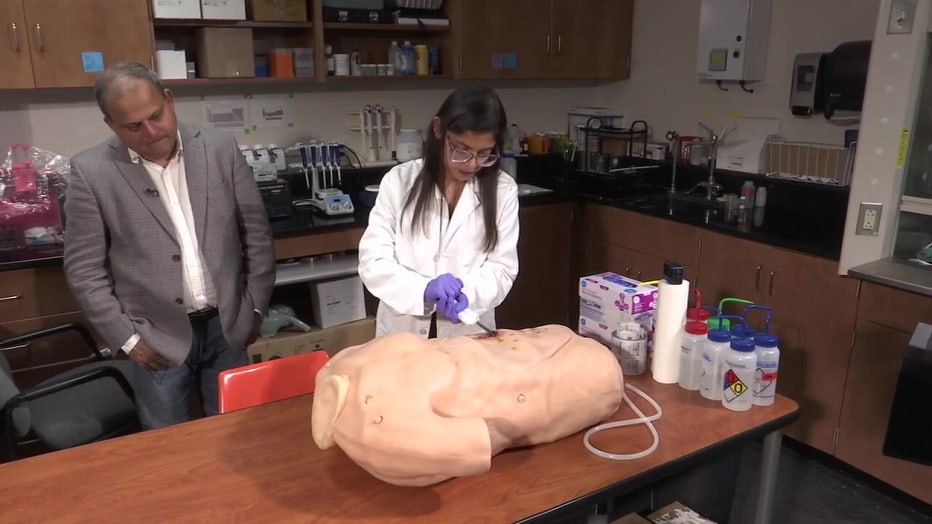
The expanding foam both fills the wound and applies pressure, helping control bleeding within seconds. In lab demonstrations using simulated deep wounds, the foam sealed irregular shapes effectively, reducing leakage and aiding clotting.
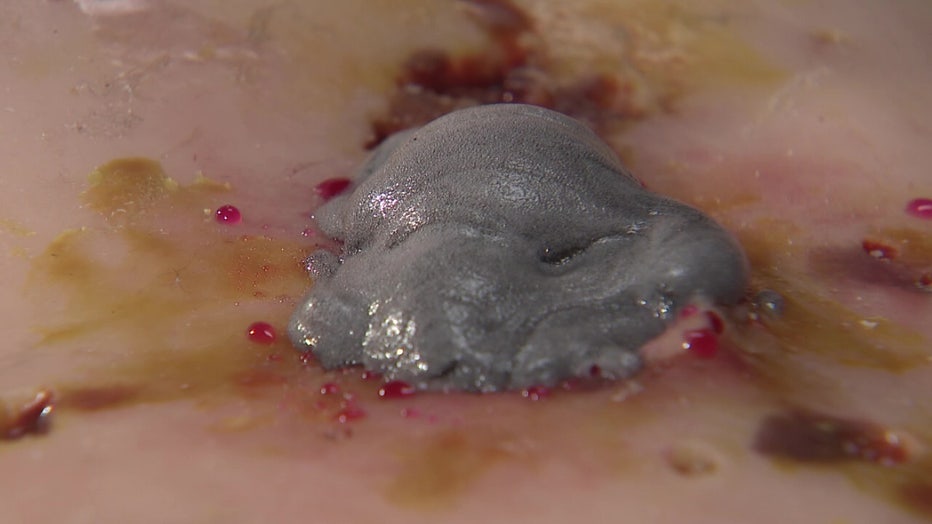
Designed for real-world emergency use
Dr. Mukhopadhyay says SilFoam stands out among other wound treatments and liquid bandages for several reasons:
- Room-temperature storage: No refrigeration required.
- Minimal training needed: Easy application process.
- Non-adhesive removal: Easily removed in surgery without sticking to tissue.
- Cost-effective: Lower production and usage costs than many current treatments.
"It actually seals all around the wound," Mukhopadhyay noted. "And the whole thing comes off very easily if needed."
READ: Florida’s Exolith Lab: Building the blueprint for a moon-based future
Custom formulations
UCF’s team isn’t stopping at the basic formulation. They are working on specialized versions of SilFoam, including:
- Antimicrobial-infused foam to prevent infection.
- Coagulant-containing foam to help blood clot faster.
They’re also using advanced tools, like a rheometer, to fine-tune the foam’s properties to ensure safety and effectiveness. "You just keep going and keep going until you get it right," said Sarkar, who often works late into the night in the lab.
What's next:
The team has already filed for patents and published their findings. The next stages include additional testing, regulatory approvals, and scaling up for commercial production.
Click here for more.
The Source: Research at the University of Central Florida.