

Flood app developed by USF team sees upgrades one year after Helene, Milton

TAMPA, Fla. - A year after launching the CRIS-HAZARD flood app in Pinellas County, University of South Florida researchers are making upgrades following the ultimate tests from Helene and Milton.
The backstory:
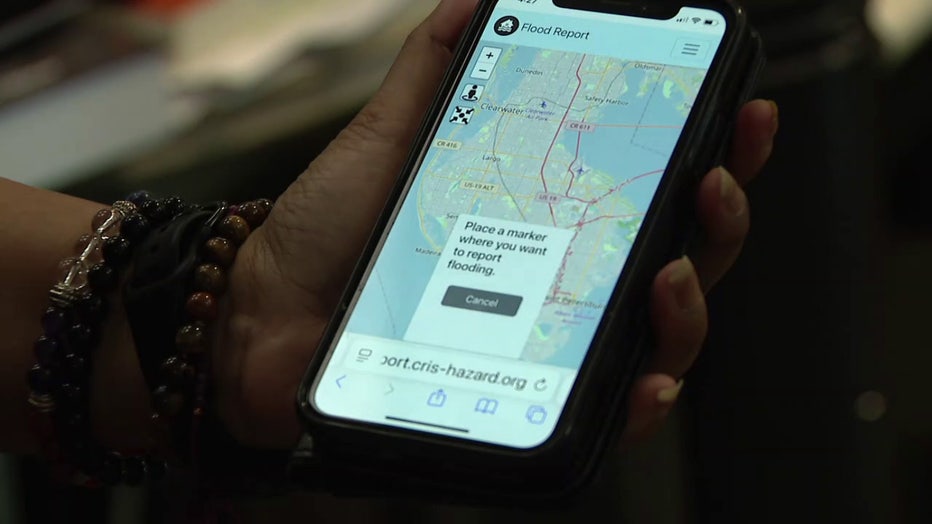
University of South Florida geosciences professor Barnali Dixon launched the CRIS-HAZARD app in September 2024 before Helene and Milton hit the Tampa Bay region. It’s a crowdsourcing app that Dixon compares the platform to the Waze app, allowing neighbors to upload photos of flooding in their neighborhood to help track and monitor rising water levels.
READ: St. Pete Mayor Ken Welch reflects on Hurricane Helene one year later
"Helene is the one we were able to characterize more, because we had more cameras in the area that experienced storm surge. However, we did get some data from Milton, and Milton actually gives us that data due to rainfall," said Dixon. "We collected really very intriguing, interesting data set through the app as well as static cameras that gives us the idea of how much water rose and when."
Neighbors uploaded their own photos of flooding in their communities to the website, aided by solar-powered cameras the USF team installed in cities across Pinellas County, including St. Petersburg, Safety Harbor and Dunedin. It uses reference images and historical images to see what’s normal and what is not. Users can also access the flood map via www.stormsquard.org.
"The way it helps us is that it allows us to take people's lived experience and translate them into data using AI, computer vision, and then it can help us understand the nature of flooding, extent and depth of flooding," said Dixon.
MORE: $1.3M federal grant helps Bay Area plan for post-disaster recovery
Dig deeper:
A year later, the app has some upgrades, like using artificial intelligence to see if a photo shows minor or major flooding. Dixon said the number of cameras grew from eight cameras at first to 31 so far this year, with a few more on the way.
"Our hypothesis over here is that if it's a no-name storm, severe no-name storm, if it floods, it will flood during hurricanes," said Dixon. "So, you want to take those pictures when you do not have to worry about evacuating or anything. If you upload those pictures, that'll be very helpful, too."
What they’ve set up is ready for counties and municipalities to take over.
"If you want to send a rescue vehicle, it is good for you to know what is the depth of the water. So, you can actually send the vehicle that's going to actually handle that depth of water," Dixon said.
READ: David Jolly proposes bold state-run insurance plan in Florida
What's next:
Dixon said the app can expand to other counties, but their National Science Foundation grant ends in 2026. So, someone would have to fund the project, she said.
Gulfport is the next city on USF’s list to install the flooding cameras and poles to measure water depth, Dixon said. She added that they work with floodplain managers to see which communities need the tracking the most.
The Source: The information in this story was gathered by FOX 13’s Briona Arradondo.