

What did Trump mean US will 'run' Venezuela? Rubio explains
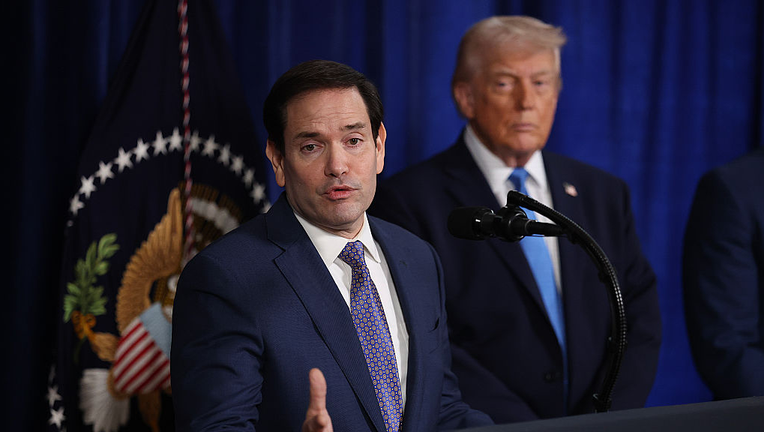
U.S. Secretary of State Marco Rubio speaks during a press conference as U.S. President Donald Trump listens at Mar-a-Lago club on January 03, 2026, in Palm Beach, Florida. During the event, President Trump confirmed that the U.S. military carried out
WASHINGTON - Secretary of State Marco Rubio said Sunday that the United States would not manage Venezuela’s day-to-day affairs, aside from enforcing an existing "oil quarantine," signaling a shift from President Donald Trump’s statement the previous day that the U.S. would run the country after the removal of leader Nicolás Maduro.
Rubio's statements on TV talk shows seemed designed to temper concerns about whether the assertive American action to achieve regime change might again produce a prolonged foreign intervention or failed attempt at nation-building.
RELATED: Trump claims US will 'run' Venezuela after Maduro captured
They stood in contrast to Trump’s broad but vague claims that the U.S. would at least temporarily "run" the oil-rich nation, comments that suggested some sort of governing structure under which Caracas would be controlled by Washington.

Trump addresses Venezuela strike, Maduro capture
President Trump says the US will now run Venezuela following large-scale strikes that lead to the capture of Venezuelan leader Nicolás Maduro and his wife. The president addressed the nation hours after the strike confirming that Maduro will face charges in either Florida or New York.
What they're saying:
Rubio offered a more nuanced take, saying the U.S. would continue to enforce an oil quarantine that was already in place on sanctioned tankers before Maduro was removed from power early Saturday and use that leverage as a means to press policy changes in Venezuela.
"And so that’s the sort of control the president is pointing to when he says that," Rubio said on CBS’ "Face the Nation." "We continue with that quarantine, and we expect to see that there will be changes, not just in the way the oil industry is run for the benefit of the people, but also so that they stop the drug trafficking."
RELATED: Trump claims US will 'run' Venezuela after Maduro captured
The blockade on sanctioned oil tankers — some of which have been seized by the U.S. — "remains in place, and that’s a tremendous amount of leverage that will continue to be in place until we see changes that not just further the national interest of the United States, which is number one, but also that lead to a better future for the people of Venezuela," he added.
The other side:
Leaders in Venezuela have so far pushed back, at least publicly, calling on the Trump administration to release Maduro.
Even before the operation that nabbed Maduro, experts were already questioning the legality of aspects of the administration's pressure campaign on Venezuela, including the deadly bombing of boats accused of trafficking drugs that some scholars said stretched the boundaries of international law.

Trump releases Maduro arrest photo
Trump releases Maduro arrest photo following large-scale attack on Venezuela. Maduro's wife was also captrued during the strike.
Trump repeated vow US would ‘run’ Venezuela
The backstory:
Trump's vow to "run" Venezuela, repeated more than half a dozen times at a news conference in Florida on Saturday, sparked concerns among some Democrats. It also drew unease from parts of his own Republican coalition, including an "America First" base that is opposed to foreign interventions, and also from observers who recalled past nation-building efforts in Iraq and Afghanistan.
Rubio dismissed such criticism, saying that Trump’s intent had been misunderstood.
"The whole foreign policy apparatus thinks everything is Libya, everything is Iraq, everything is Afghanistan," Rubio said. "This is not the Middle East. And our mission here is very different. This is the Western Hemisphere."
Rubio also suggested the U.S. would give Maduro’s subordinates now in charge time to govern, saying, "We’re going to judge everything by what they do." And though he did not rule out boots on the ground in Venezuela, Rubio said the U.S, which has built up its presence in the region, was already capable of stopping drug boats and sanctioned tankers.
A day earlier, Trump told reporters, "We’re going to run the country until such time as we can do a safe, proper and judicious transition." He later pointed to his national security team with him, including Rubio and Defense Secretary Pete Hegseth, and said it would be done for a period of time by "the people that are standing right behind me. We’re gonna be running it we’re gonna be bringing it back."
The White House declined to comment beyond what Trump said Saturday.
The Source: The Associated Press contributed to this report. The information in the story comes primarily from public remarks by Secretary of State Marco Rubio during Sunday television appearances, including on CBS’ Face the Nation, as well as statements by President Donald Trump at a news conference in Florida the previous day. This story was reported from Los Angeles.