

Florida still 50th in teacher pay despite salary increases, report finds
Florida ranks last in teacher pay, report says
For the third year in a row, Florida has ranked last in teacher pay. FOX 13's Kellie Cowan breaks down why new initiatives haven't necessarily raised teacher's pay.
TAMPA, Fla. - Despite yearly increases in teacher pay, Florida ranked 50th in the nation in average teacher pay for the third year in a row.
Florida Teacher Pay Rose, Yet Still Ranks Last
Florida’s average teacher salary increased to an estimated $56,663 for the 2024-25 school year, up 3.3% from the year before.
Despite the increase, Florida ranked 50th in the nation in average teacher pay for the third year in a row, according to the National Education Association’s latest report. The same report shows Florida’s inflation-adjusted teacher pay is down more than 12% over the last decade.

"Our wages have been stagnant. We're not surprised by this at all," said Florida Education Association President Andrew Spar.
The broader contrast in the data is striking. Florida’s average starting teacher salary was reported at $49,435, ranking 19th nationally, while its overall average salary remained at the bottom of the list.
Last year, Governor Ron DeSantis said Florida had continued directing major state money toward teacher pay.
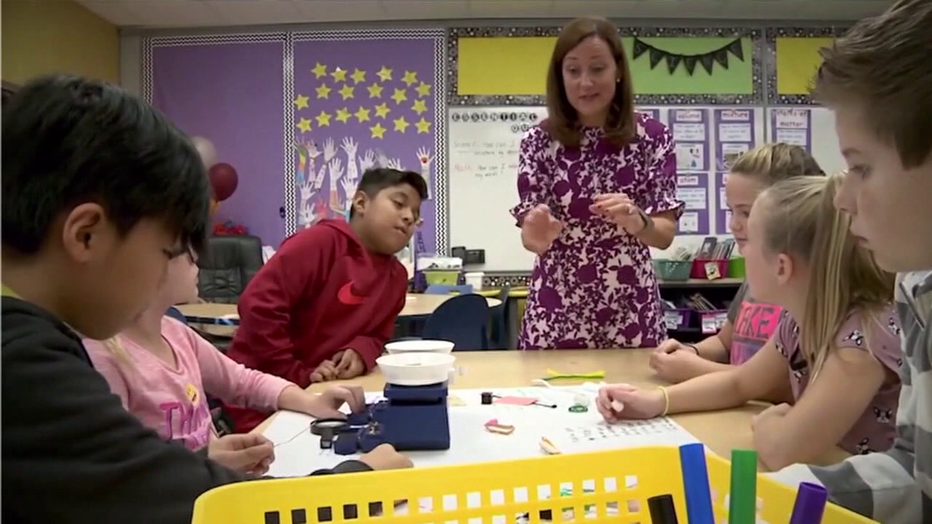
His office said in July 2025 that the state had invested more than $6 billion in teacher pay increases since 2019. Even with those investments, Florida’s national standing has not improved in the new NEA data.
FEA Says Experienced Teachers Are Leaving
Spar says the lack of wage growth has created attrition among mid-career educators and prompting experienced teachers to either leave Florida or leave the profession entirely.
"We are seeing a mass exodus of teachers, specifically in the 10 to 25-year timeframe," he said. "That is not normal. Usually, those are career educators. They stay until they retire. They’re leaving before they retire, they’re going to other states, they’re go to other areas, other professions because they just can’t seem to make ends meet."
The cost of living in Florida, particularly in major cities like Miami and Tampa, has exploded in recent years.
According to a newly published report from Florida Tax Watch, cost-of-living growth has surged by 5.8% each year in the 2020s, a nearly five-fold hike.
What they're saying:
Spar said Florida’s stronger ranking for starting salaries does not solve the bigger problem: teachers are getting in the door, but too many cannot afford to stay.
"This new ranking shows that we now rank 19th in the nation in starting teacher pay," he said. "But when you think about that, going from 19th in the nation in starting teacher pay to 50th in the nation in average teacher pay, that’s a significant drop-off."
The NEA data backs up that divide. Florida’s estimated average teacher salary for 2024-25 sits at $56,663, while the national average is $74,495.
Spar also pushed back on the governor’s argument that he has done more than previous administrations to boost teacher pay.
"It’s just not simply true," Spar said. "When you look at average teacher pay in the state of Florida, it’s gone up about 12% in the eight years that Governor DeSantis has been in office. That’s less than 2% a year. Cost of living is significantly higher than that."
Inside The Schools
Spar said the result is no longer just a staffing issue. He said it is increasingly a student learning issue, too.
"We are seeing constant teacher turnover and staff turnover in our schools. That hurts kids," he said.
He described the disruption through his own daughter’s experience in Volusia County, saying she has had a full roster of teachers for an entire school year only once in the past five years. In other years, he said, classes went weeks or even months without permanent teachers after educators left midyear.
"That has become the norm in the state of Florida when it comes to education," Spar said.
That account mirrors what education advocates have said publicly as districts across Florida continue trying to fill vacancies and stabilize staffing. The state had about 172,204 teachers in public schools in 2025-26, according to NEA estimates, but union leaders argue the bigger challenge is retention, not just recruitment.
Big picture view:
Spar said some lawmakers acknowledge the pay issue privately, but he blames politics for blocking broader changes.
He pointed to Senate-backed proposals that would have addressed teacher pay inequities, multi-year contracts, and school funding issues, saying they advanced in the Senate but stalled in the House this spring.
"When voters in the state of Florida say it is important to invest and support our public schools, and lawmakers turn their backs on it because of political agendas, that’s not in the best interests of students or families in the state of Florida," he said.
What we don't know:
It is still unclear whether state lawmakers will make any major changes to salary policy in the next budget cycle, or whether additional state investments would be structured to lift veteran teacher pay in a way that meaningfully changes Florida’s national ranking. It is also not yet clear how much teacher turnover in the coming school year will mirror the attrition Spar described.
The Source: This article is based on the National Education Association’s Rankings of the States 2025 and Estimates of School Statistics 2026 report, statements from Gov. Ron DeSantis, and FOX’s interview with Florida Education Association President Andrew Spar.