

USF launches federal partnership to combat human trafficking across Tampa Bay region
USF teams up with HSI to fight human trafficking
Tampa Bay is one of the top human trafficking locations in the nation. USF and HSI are teaming up to prevent it. FOX 13's Danielle Zulkosky reports.
TAMPA, Fla - A University of South Florida program officially partnered with federal agents Friday to strengthen strategies against human trafficking.
Federal human trafficking partnership
What we know:
The BRIGHT Project officially joined forces Friday with Homeland Security Investigations offices in Tampa and Miami.
Leaders signed a memorandum of understanding, marking the first official law enforcement partnership for the university-backed project.
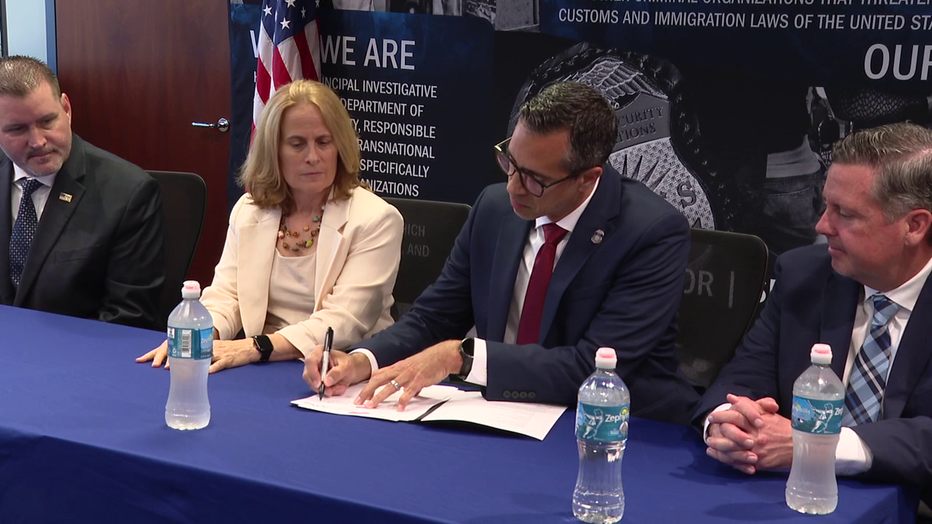
Officials from USF and HSI sign agreement to combat human trafficking
The initiative provides critical resources directly to trafficking victims while simultaneously helping law enforcement teams streamline their investigations.
Dr. Shelly Wagers, a USF criminology professor and BRIGHT Project director, finalized the agreement alongside federal authorities to coordinate regional anti-trafficking operations.
Florida trafficking risk factors
What we don't know:
Authorities have not released a specific timeline for when they hope to scale this localized network model to other states across the country.
It remains unknown how many active human trafficking investigations are currently open within the Tampa Bay region.
Officials did not specify how many tech tools or research assistants are currently deployed by USF to assist federal agents with data processing.
Human trafficking data trends
By the numbers:
- 3: The national rank of the state of Florida regarding the total volume of human trafficking cases.
- 2: The regional rank of the Bay Area as the worst area for human trafficking within the state.
According to researchers, traffickers actively look for individuals dealing with poverty, young age and a lack of education to exploit.
Vulnerabilities and geography
Dig deeper:
The state is highly vulnerable to human trafficking networks, in large part due to its unique geography.
Florida features a vast infrastructure of ports, interstate highways and international airports that provide criminals with various ways of moving people.

One of Tampa's many access points for human trafficking
The BRIGHT Project creates direct pipelines to remove individuals from harm quickly before exploitation escalates.
Law enforcement resource management
What they're saying:
"The state of Florida sits number three as far as numbers of trafficking," Wagers said. "So, we are a high-risk state. Age, poverty, lack of education, different things like that. Traffickers look for individuals with vulnerabilities they can exploit."
"The Bright Network enhances our ability to rapidly connect survivors with essential services, including safe housing, healthcare, counseling and other critical resources," Jose Figueroa, the acting special agent in charge for HSI Miami, said.
"Any tool that helps us connect victims and services more," Mike McCombs, the acting special agent in charge for HSI Tampa, said. "Quickly and more efficiently is certainly something my investigators are keenly needing and aware of."
Right now, a single special agent might filter through hundreds of tips, but university researchers are building specialized tools to parse the data.
"That helps them with their manpower, but it also assists with us not missing as many potential victims and filtering out the leads that aren't potentially even trafficking victims," Wagers said.
The Source: The information in this story was gathered from an official announcement by the University of South Florida and Homeland Security Investigations, who explained how we got it, as well as on-the-record statements from a USF criminology professor and BRIGHT Project director, as well as the acting special agents in charge for HSI Miami.