

America 250: How grit and ingenuity fueled the race to the moon

Reflecting on the space race ahead of America 250
The American Revolution started with trailblazers facing steep odds and little margin for error, solving problems by adapting. That same American spirit would later take humanity to the moon — but the U.S. did not start the space race in the lead. FOX 13's Craig Patrick reports.
CAPE CANAVERAL, Fla. - The American Revolution started with trailblazers facing steep odds and little margin for error, solving problems by adapting. That same American spirit would later take humanity to the moon — but the U.S. did not start the space race in the lead.
Cold War space race
What we know:
Following World War II, many of the top rocket scientists from Nazi Germany — who developed the V-2, the first rocket to reach space — were divided between the United States and the Soviet Union. As the Soviet empire expanded across Eastern Europe, the Cold War began.
It was a battle of communism versus the free market, triggering a high-stakes race to win over uncommitted nations around the world.
Early rocket failures
The backstory:
The Nazi scientists who joined the Soviets helped them take the early lead, launching Sputnik 1, the first artificial satellite, into orbit.
While the U.S. enlisted the help of former Nazi scientists like Wernher von Braun to build a rocket station at Cape Canaveral, some of America's early rockets blew up.
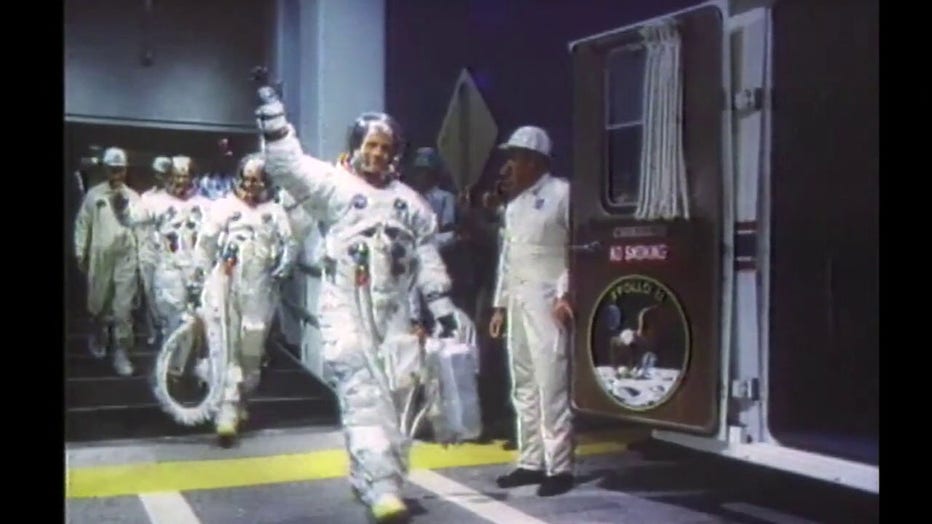
However, the nation learned from those failures.
Rapid agency progression
Timeline:
President Dwight D. Eisenhower created a new civilian agency, NASA, to manage space travel. The agency progressed through a rapid, strategic timeline:
- The Mercury Program: NASA introduced the "Mercury Seven," a group of pioneering astronauts who took turns flying single-seat capsules in Earth's orbit.
- The Gemini Missions: These two-seater missions taught astronauts how to maneuver and dock in space. It also tested their grit. During Gemini 8, a critical control system failed, sending the spacecraft spinning out of control until commander Neil Armstrong successfully stabilized the ship.
- The Apollo Missions: Designed to take three astronauts to the moon, the program faced a devastating setback when a fire broke out during an Apollo 1 training exercise, killing three astronauts. America mourned, learned from the disaster, and regrouped. To beat the Soviets, Apollo 8 skipped planned Earth-orbit tests and successfully flew laps around the moon on Christmas Eve in 1968.
Presidential space goals
Why you should care:
The rapid acceleration of the space program was driven by President John F. Kennedy, who upped the ante in 1962. Recognizing that a bold goal could unite the nation, he declared: "We choose to go to the moon in this decade and do the other things—not because they are easy, but because they are hard."
Unifying lunar achievement
What they're saying:
Years later, after securing the ultimate victory in the space race, Neil Armstrong reflected on the unifying power of the achievement: "Ideological differences fade in the presence of the overpowering force of pride in what we do and what Americans have achieved."
Moon landing ingenuity
Big picture view:
On July 20, 1969, Armstrong and Buzz Aldrin planted the American flag on the moon, showcasing American exceptionalism. But, the landing itself required intense on-the-fly problem-solving.
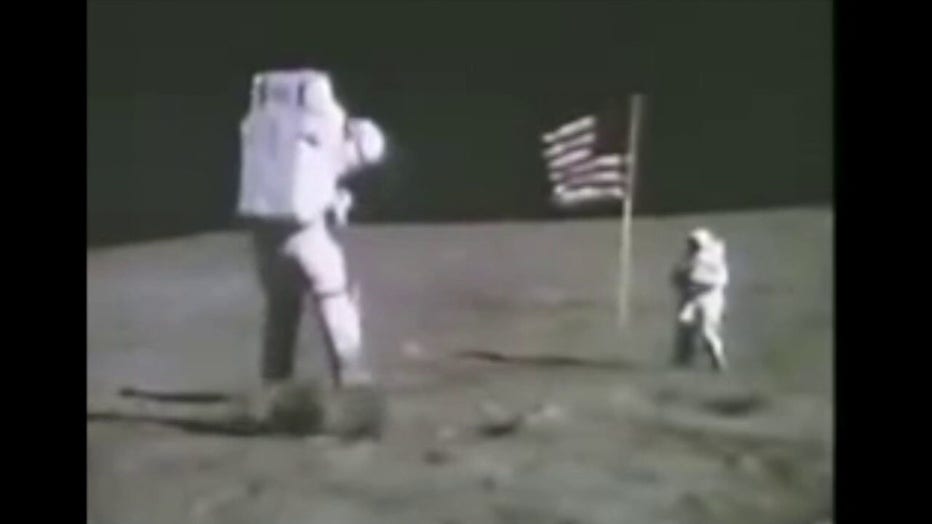
During their descent, the lunar module's computer malfunctioned, steering them toward a crater. After they safely landed, a switch needed to launch the module back to the command ship broke off the panel.
Using quick thinking, Aldrin found a writing pen in his spacesuit, plugged it into the circuit breaker, and turned it into a makeshift switch. It was a prime example of facing adversity and using ingenuity to overcome it.
That can-do spirit led 10 other Americans to walk on the moon, and eventually led to the creation of the Space Shuttle program, which launched the modern satellite and information age.
Future deep space exploration
What's next:
The discovery of ice beneath the lunar surface is now driving America back to the moon. Future missions aim to use solar power to convert that water into fuel, establish lunar mining operations, and eventually use the moon as a launching pad for crewed missions to Mars.
There will be steep hurdles, and skeptics may say it cannot be done. But as history has shown over the last 250 years, overcoming the impossible is what fuels the next great chapter in the story of America.
The Source: This historical feature was produced by FOX 13’s Craig Patrick. It incorporates historical NASA records, archival newsreels, and recorded audio from Presidents Dwight D. Eisenhower and John F. Kennedy, as well as astronauts John Glenn, Neil Armstrong, and Buzz Aldrin.