

Archaeologists uncover site of America’s first Christmas near Florida capitol

America's first Christmas found near Tallahassee
Archaeologists made the discovery of a lifetime about a mile from our state capitol. FOX 13’s Craig Patrick traveled to Tallahassee to show us how it all played out.
TALLAHASSEE - Florida archaeologists have confirmed a stunning find hidden in plain sight: the site of Hernando de Soto’s winter encampment of 1539–1540 — and the location of the first Christmas ever celebrated on land that would become the United States. The hilltop sits just steps from Florida’s state archaeology headquarters in Tallahassee.
"It was really astonishing that it’s here in Tallahassee," said Florida archaeologist Nicholas Yarbrough, who has helped analyze thousands of artifacts from the site. "It was kind of in plain sight but just underground."
The discovery traces back to 1987, when archaeologist Calvin Jones noticed construction equipment had churned up pieces of unusually old pottery. He stopped to investigate and spotted fragments of Spanish olive jars from the early 1500s. Soon, excavators uncovered armor pieces, crossbow bolts, and coins dating to the era of the De Soto expedition.
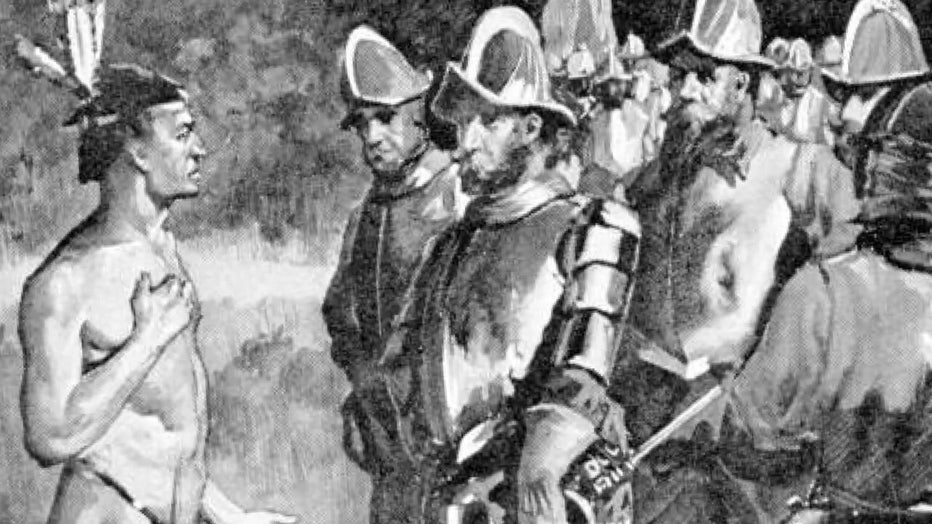
"Such a significant site was under our feet the whole time," Yarbrough said. "What they found were thousands of artifacts related to a Spanish occupation, which was eventually identified as the De Soto winter encampment."
That encampment became the backdrop for the first Christmas celebrated in what would become the United States.
A turning point in Florida and American history
To put the discovery in context, FOX 13 consulted two leading experts:
- Dr. Steven Noll, University of Florida historian specializing in Florida’s cultural and political development.
- Dr. David Arbesú, University of South Florida professor and expert in medieval Spanish language, literature, and the chronicles of the De Soto expedition.
Both scholars say the finding significantly deepens our understanding of Florida’s earliest documented encounters between Europeans and Native Americans — as well as the historic roots of Christmas in North America.
"It would have been something totally different than you would expect today," Dr. Arbesú said.
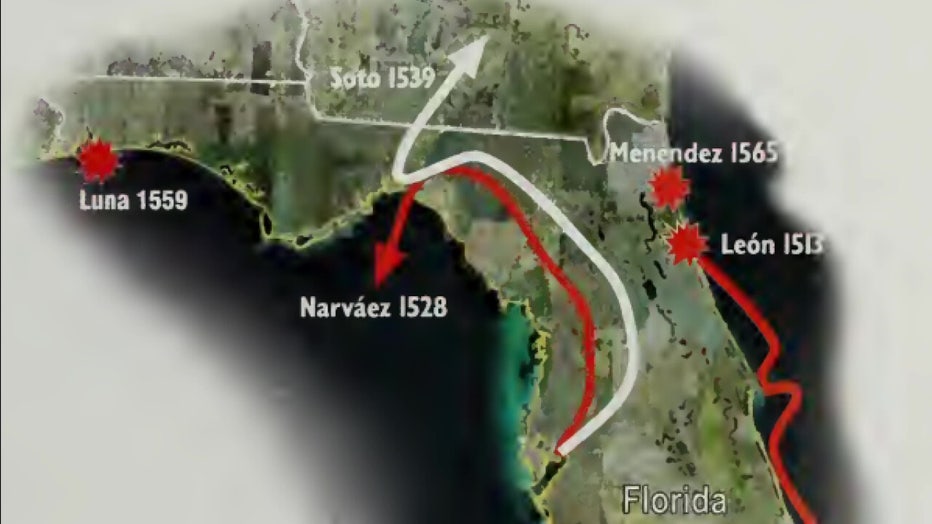
The De Soto expedition — roughly 600 soldiers, settlers, priests, horses, and pigs — landed near present-day Bradenton in 1539. Reenactors at the De Soto National Memorial still retrace that arrival every year. According to Dr. Noll, the expedition followed a path remarkably similar to today’s I-75 corridor.
"And marches up I-75, which is as crowded then as it is now," he joked.
The group brought a herd of pigs along as a mobile food supply — animals that would later escape and spawn the feral hogs that roam Florida today.
READ: The story of the Christmas orange and how Florida keeps the tradition alive
A violent Winter before Christmas
Their northward march triggered repeated conflict.
"The Florida natives were always really, really hostile to the Spaniards," Dr. Arbesú said. "And the expedition was hostile in return," FOX 13’s Craig Patrick noted.
"Yes, yes, of course," Arbesú replied. "De Soto never hesitated to be very cruel and harsh with the Indians when he encountered them."
By the time the Spaniards reached Apalachee territory — located on the same ground as present-day Tallahassee — tensions were explosive. Dr. Noll emphasized that De Soto’s force seized Apalachee homes and winter food stores, prompting ongoing clashes.
"Pretty tense situation," Noll said. "The Apalachee are a rather powerful kingdom, as it were, and these are interlopers, better armed, but not nearly as populous."
Historical chronicles describe roughly 250 Apalachee homes at the site. The Apalachee evacuated when the heavily armed Spaniards approached.
America’s first Christmas
With both sides clashing and food scarce, the holiday looked nothing like the modern celebration.
"It was not a festive Christmas as we would celebrate it today," Yarbrough explained. "There were no Christmas trees. There was probably not a lot of decoration. They were really kind of fighting for their lives every day."
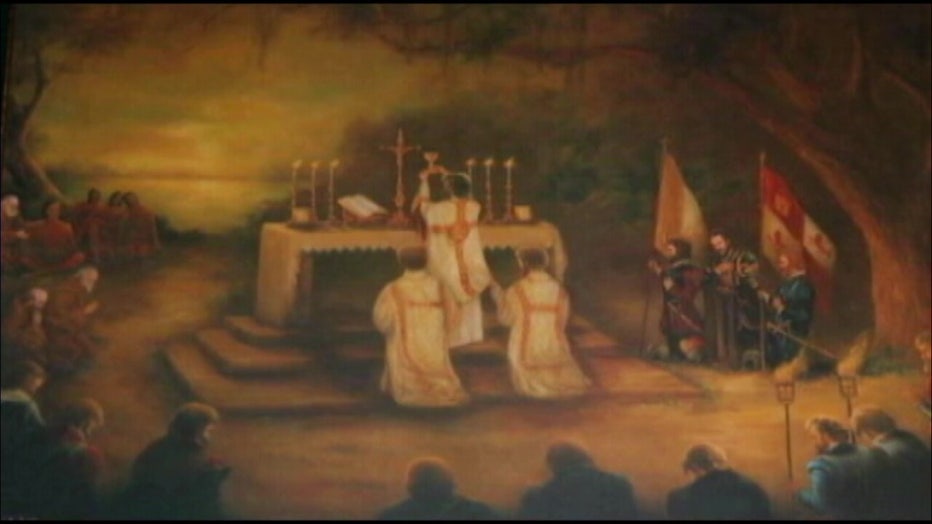
But the Spaniards were devout Catholics. Dr. Arbesú says they almost certainly held at least one Christmas Mass, likely in Latin, possibly at midnight and again in the morning.
"There would’ve been a celebration with food," Arbesú said, "but nothing like we would see today."
Dr. Noll notes the meal likely combined pork from the expedition’s pigs with traditional Apalachee staples such as corn.
Big picture view:
The expedition eventually left Tallahassee without finding the riches it sought — but its presence left an imprint on Florida that persists.
"With genetic studies, we know that a lot of the feral pigs in the United States actually descend from those that De Soto carried and then escaped," Arbesú said.
The archaeological site, once nearly bulldozed, is now recognized as one of the most significant early-colonial sites in the United States.
The Source: On-site reporting and investigation by FOX 13's Craig Patrick. Interviews with Nicholas Yarbrough, Florida archaeologist. Expert analysis from Dr. Steven Noll, University of Florida. Expert analysis from Dr. David Arbesú, University of South Florida. Artifacts and archaeological records from the Florida Bureau of Archaeological Research.