

Florida governor's race: How David Jolly and Byron Donalds took very different paths to the top
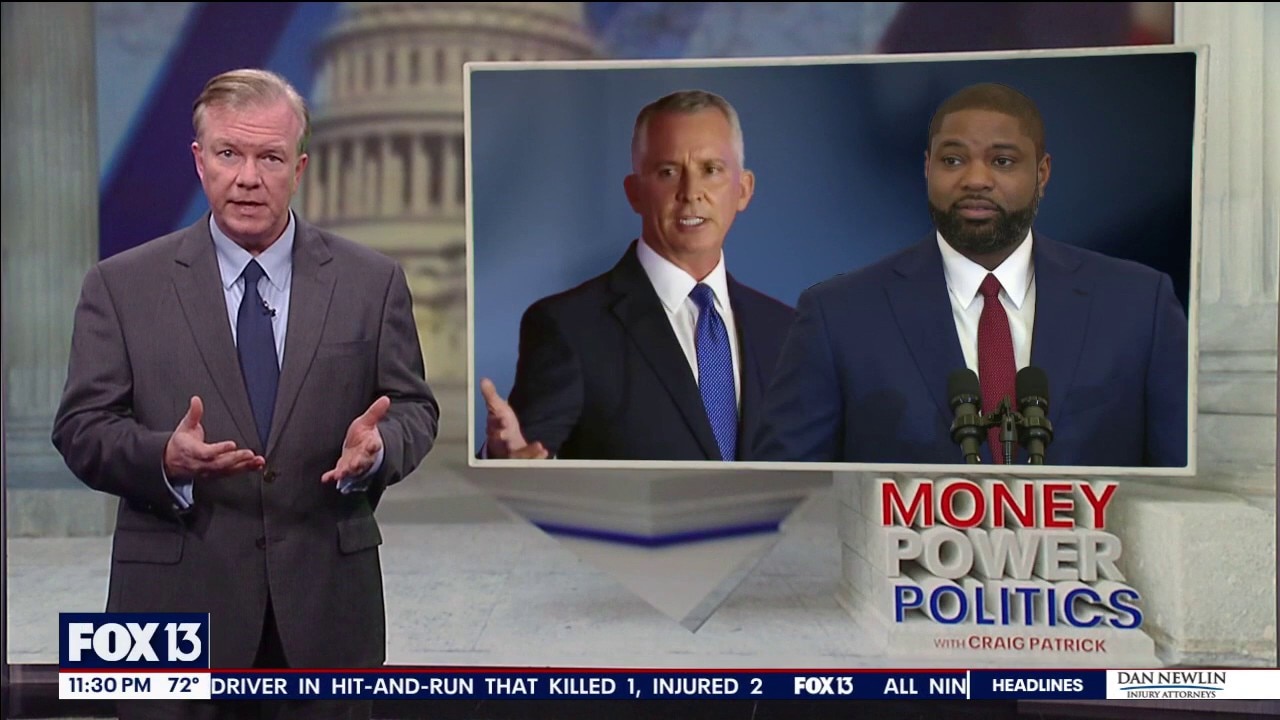
The choice; Donalds v. Jolly
Who are David Jolly and Byron Donalds? Craig Patrick examines how they became the people they are—and what that tells us about the choices they might make in power.
TAMPA, Fla. - As Florida voters prepare to choose their next governor, the candidates offer a striking contrast.
Two candidates, two political journeys
What we know:
Democrat David Jolly once worked at the center of the Republican establishment. Republican Byron Donalds grew up a Democrat before embracing the conservative movement and rising through the GOP.
Their stories extend beyond party switching. They reflect a decade of political upheaval, the changing Republican Party and two very different responses to the rise of Donald Trump.
David Jolly: Republican insider to Democratic nominee
The backstory:
David Jolly, the son of a Baptist minister, built his early political career inside the Republican establishment. He learned Washington's inner workings as general counsel and a senior aide to longtime Florida Congressman Bill Young, working alongside the chairman of the House Appropriations Committee. The experience gave Jolly an understanding of how Congress could direct federal money to Florida. He later put that knowledge to work as a lobbyist.
When Young died, Jolly ran for his mentor's seat in a 2014 special election. Despite trailing Democrat Alex Sink in polling in the final week, Jolly won, 49% to 47%. But the Washington he entered as a congressman was increasingly gridlocked.
A fight over Washington — and his own party
During the 2016 Zika virus outbreak, Jolly became frustrated with delays in federal funding. He brought a jar of mosquitoes to the House floor to illustrate the urgency of the crisis.
"Can you imagine, colleagues, the fear and anxiety in this chamber if these 100 mosquitoes were outside this jar, not inside this jar?" Jolly asked. "This is the fear of Floridians right here."
His criticism soon turned toward his own party's campaign fundraising system.
Jolly said Republican leadership expected new members of Congress to spend hours raising money, with one fundraising target reaching $18,000 a day. He took his concerns to 60 Minutes, describing the process as "a cultlike boiler room."
Jolly introduced the STOP Act, which would prohibit members of Congress from personally soliciting campaign contributions.
"I pulled the curtain back a little bit on what I think is a first-rate scandal of today's political generation, which is fundraising is more important than politics," he said.
The move alienated Jolly from Republican leadership, and the national Republican party pulled back financial support for his reelection in 2016.
Breaking with Trump
Jolly also became an outspoken Republican critic of Donald Trump during the 2016 presidential campaign.
He called on Trump to withdraw his candidacy, questioned his fitness to serve and criticized what he described as Trump's bullying and bigotry. That same year, redistricting placed Jolly in a Democratic-leaning congressional district. He lost his seat to Charlie Crist. In January 2017, Jolly said his willingness to challenge both parties had left him politically isolated.
"There's a reason that I was abandoned by my own party at the end and attacked by the Democratic Party," he said. "It's because I was willing to take on what we all know is wrong."
From Republican to independent to Democrat
After leaving Congress, Jolly found himself increasingly at odds with the direction of the Republican Party.
"Where does a guy like me go, Craig?" he asked in a 2017 interview. "A center-right Republican looking for a mainstream agenda in a Trump Republican Party. There is nowhere to go."
Jolly left the Republican Party in 2018 and spent several years as an independent. In 2025, he officially registered as a Democrat and launched his campaign for governor.
Asked how he could expect to win a statewide election as a Democrat after spending much of his career as a Republican, Jolly said his political journey would be central to his campaign.
"I want my journey to be part of a campaign. Critics will reflexively say, 'He changed his mind.' I did… You know who's changed the most? Republicans who used to be for less government, for lower taxes, for fiscal responsibility, now are defending more deficits and more debt. They've certainly changed. So let them defend their change and I'll defend mine, and I feel really good about that," Jolly said.
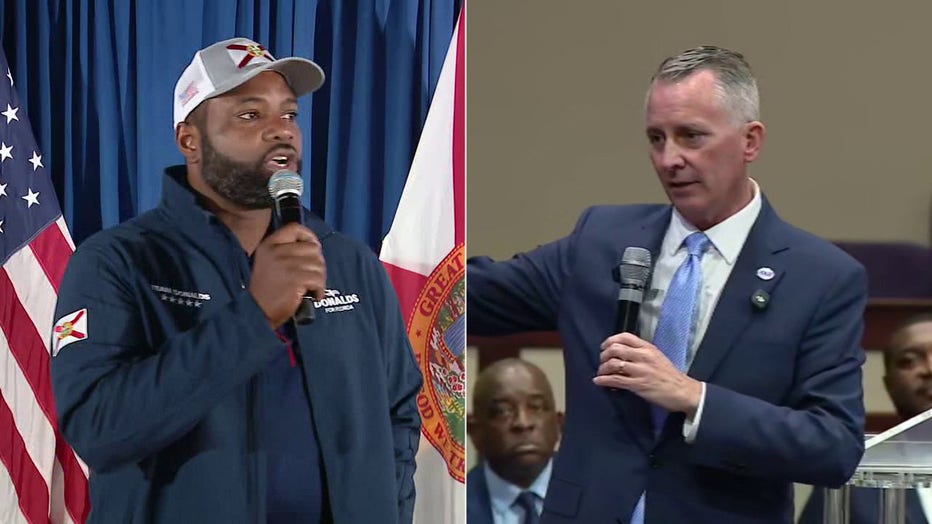
Byron Donalds: Democratic upbringing to conservative political star
The backstory:
Byron Donalds' political journey began in a very different place. Raised in Brooklyn by a single mother, Donalds grew up a Democrat. He moved to Florida at 17, arriving on a Greyhound bus with a trunk full of clothes.
Donalds faced two criminal cases while attending college in Florida. In 1997, when he was 18, he faced a misdemeanor marijuana possession charge that was dismissed after he completed a pretrial diversion program.
"I was leaving a party. Officers came up, asked me if I would empty my pockets. I said, yes, of course. I had a dime bag of marijuana in my pocket. That's the story," Donalds told CBS Miami in 2026.
In 2000, Donalds was arrested on a second-degree felony charge of bribery stemming from a bank-debit-card transaction. Donalds has described the underlying conduct as theft, not bribery. He pleaded no contest and served one year of probation. The record was later sealed and ultimately expunged, according to his campaign. In a 2014 interview with Fox 4 in Fort Myers, Donalds said a woman offered him $1,000 for his debit card and PIN.
"I never got the thousand dollars, but I had to make restitution to the bank in excess of $7,000," he said.
A turning point
Donalds has described that period as a low point in his life.
"I was really at the bottom in life, had already been arrested twice — made a ton of mistakes," he said.
While working as a waiter, Donalds said he served a party returning from a religious revival. He described the encounter as a turning point in his Christian faith.
"...and the Lord told me to stop running…and I gave my life to Christ in that parking lot," he said.
Donalds later built a career in banking, finance and insurance before moving to Southwest Florida.
From school choice to the conservative movement
Donalds and his wife, Erika, became active in the school-choice movement. He has said his own experience leaving public school shaped his views on education policy.
"My mother took me out of public schools because she could see public education was failing me," Donalds said at the Republican National Convention in 2024. "But what about those kids who can't scrape money together for private school? Don't those kids who grew up like I grew up deserve the same chance that I had?"
When Donalds ran for Congress in 2020, he positioned himself to the right of the Republican primary field, aligning closely with the emerging MAGA movement.
He won the primary by a few hundred votes.
"For a long time, I've been in the trenches in a lot of these battles dealing with conservatism," Donalds said.
A rising voice in Trump's Republican Party
Once in Congress, Donalds became a regular on conservative television, a leading voice in the House Freedom Caucus and a prominent critic of Democratic policies. He became known for his outspoken positions on immigration, cultural issues and race. By 2023, Donalds had become a national conservative figure. His populist colleagues nominated him for speaker of the House, and he emerged as a prominent surrogate for Trump. Donalds secured Trump's endorsement in the Florida governor's race, giving him the backing of the president in a state with approximately 1.5 million more registered Republicans than Democrats.
What their journeys tell us about the race
Jolly and Donalds confronted the same changing Republican Party and made very different choices. Jolly broke with the party's leadership over its fundraising system and with Trump over his politics. After years as an independent, he joined the Democratic Party. Donalds embraced the conservative movement, aligned himself with Trump and rose to national prominence within the Republican Party. Their differences extend to policy. The next governor will face consequential decisions involving education, health care, the environment, data centers, home insurance and more.
FOX 13 has interviewed both candidates and produced in-depth reports examining where they stand on those issues, what they would change and how they would lead Florida.
What's next:
Voters can stream the candidates' interviews and policy explainers on the FOX Local app.
FOX 13 is also presenting one-on-one interviews with candidates in other key races, including the St. Petersburg mayoral contest and congressional races that could help determine control of Congress.
FOX 13 will provide live coverage as election results come in.
The Source: This report draws on FOX 13 Political Editor Craig Patrick's interviews with David Jolly and Byron Donalds, archival interviews and public statements by both candidates, congressional footage, and reporting on their political careers. The candidates' descriptions of their personal experiences and political evolution are attributed to them. Historical election results and public offices are presented as documented events.