

Trump signs proclamation updating H-1B visa rules

President Trump signs 'gold card' executive order
President Donald Trump signed an executive order to create the "Gold Card" visa program on Friday. Trump also answered questions from reporters inside the Oval Office.
WASHINGTON - President Donald Trump on Friday signed a proclamation that will require a new annual fee of $100,000 for H-1B applicants.
H-1B visas are meant to bring the best and brightest foreigners for high-skilled jobs that tech companies find difficult to fill with qualified U.S. citizens and permanent residents.
The program instead has turned into a pipeline for overseas workers who are often willing to work for as little as $60,000 annually. That is far less than $100,000-plus salaries typically paid to U.S. technology workers.
RELATED: Trump reveals 'gold card' $5M immigration pathway with his face on it
What they're saying:
Trump insisted that the tech industry would not oppose the move. "I think they're going to be very happy," he said.
Notably, First lady Melania Trump, the former Melania Knauss, was granted an H1-B work visa in October 1996 to work as a model. She was born in Slovenia.
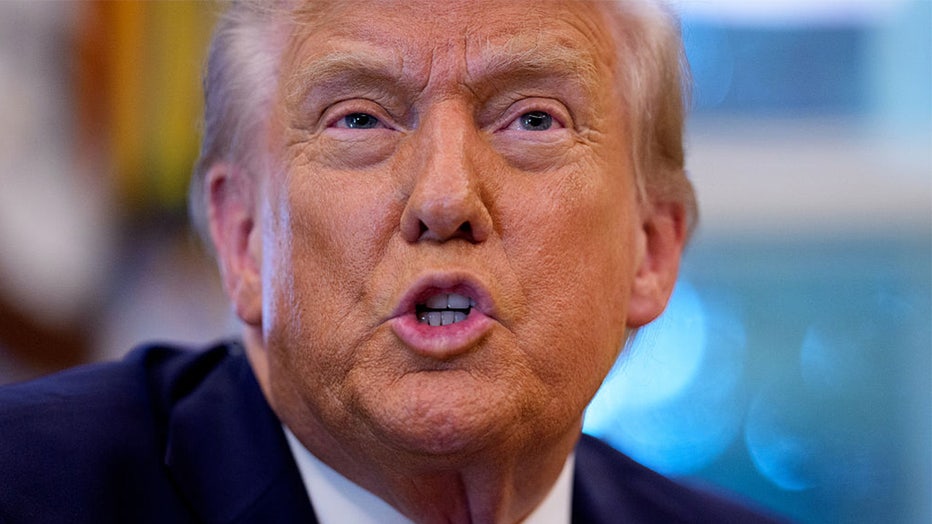
President Donald Trump speaks before signing executive orders in the Oval Office at the White House on Sept. 19, 2025 in Washington, DC. Photo by Andrew Harnik/Getty Images)
Trump gold card
Trump also announced he will start selling a "gold card" visa with a potential pathway to U.S. citizenship.
The "Trump Gold Card" will be available for a processing fee and a $1 million contribution after vetting. For companies, it will cost $2 million. The "Trump Platinum Card," meanwhile, will be available for a $5 million contribution and will allow foreigners to spend up to 270 days in the U.S. without being subject to U.S. taxes on non-U.S. income. Trump announced a $5 million gold card in February to replace an existing investor visa — this is now the platinum card.
What is the H1-B program?
The backstory:
The H1-B program was created in 1990 for people with a bachelor’s degree or higher in fields where jobs are deemed hard to fill, especially science, technology, engineering and math. Critics say they allow companies to pay lower wages with fewer labor protections.
Historically, these visas — 85,000 per year — have been doled out through a lottery system.
This year, Amazon was by far the top recipient of H-1B visas with more than 10,000 awarded, followed by Tata Consultancy, Microsoft, Apple and Google. Geographically, California has the highest number of H-1B workers, according to UCIS.
The other side:
Critics say H-1B spots often go to entry-level jobs, rather than senior positions with unique skill requirements. And while the program isn’t supposed to undercut U.S. wages or displace U.S. workers, critics say companies can pay less by classifying jobs at the lowest skill levels, even if the specific workers hired have more experience.
As a result, many U.S. companies find it cheaper simply to contract out help desks, programming and other basic tasks to consulting companies such as Wipro, Infosys, HCL Technologies and Tata in India and IBM and Cognizant in the U.S. These consulting companies hire foreign workers, often from India, and contract them out to U.S. employers looking to save money.
The Source: Information for this article was taken from The Associated Press.