

Amendment 3: New legislative leaders skittish on DeSantis' property tax special session
TALLAHASSEE, Fla. - While not rejecting the idea of a special session before the end of the year outright, Florida’s new legislative leaders aren’t rushing to enact additional measures around the massive property tax cut voters approved in the midterm elections.
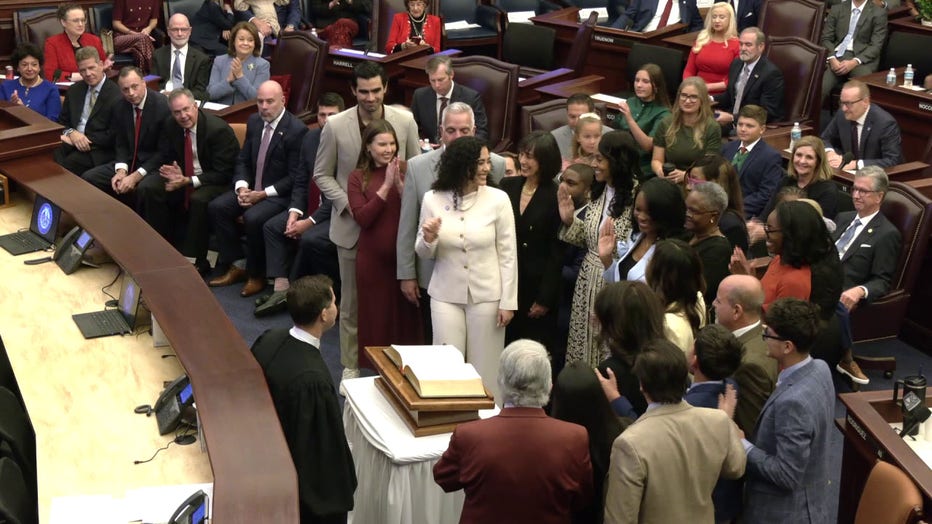
Hours after formally being handed the gavels for their respective chambers, Senate President Jim Boyd, R-Bradenton, and House Speaker Sam Garrison, R-Fleming Island, told reporters they anticipate any issues around Amendment 3 to be handled in the 2027 regular session. That’s counter to what outgoing Gov. Ron DeSantis has sought, urging a special session to address Amendment 3 issues before the end of the year.
"There'll be a lot of concerns that we need to address and talk about," Boyd said. "We believe there's time later on, during the regular session, to talk about this and give it the time and the attention that it needs."
A day after the general election, DeSantis said he would work with the Legislature on the timing of a special session before his term ends Jan. 5, including discussion of providing funds for rural areas with low tax bases that will be hard hit by the new measure.
The amendment raises the homestead exemption from $50,000 to $150,000 in 2027 and $250,000 in 2028, but the increased exemption doesn’t apply to the portion that pays for public schools. Those who have not established permanent Florida residency as of Dec. 31 would have to wait five years before qualifying for the expanded exemption.
The measure also caps annual property value assessment increases on non-homestead properties at 5 percent, down from the current 10 percent.
State economists project the measure to save property owners and cost local governments $4.93 billion the next fiscal year, rising to nearly $12 billion in five years.
Boyd acknowledged there’s concerns about shifting the tax burden, as critics of the amendment warned local governments will recoup lost revenue through increased user fees and sales taxes.
Garrison said there is time for legislative discussions as local governments have the summer to plan for the effects of the amendment when their fiscal year begins Oct. 1. The state fiscal year starts July 1.
"There's always something you can do to clean up and make sure that the things align," Garrison said. "But what we want to be able to do is give our counties and municipalities, our sheriffs, our police departments and our fire departments and public works departments all have some certainties as to what the future holds, and what they can and can't do."
The 60-day regular session begins March 2. Lawmakers will also have to discuss the issue during committee hearings in the months before the session starts.
Boyd said they are looking to hear more from DeSantis and Governor-elect Byron Donalds.
"We want to be judicious in our process," Boyd said. "Because it is a big deal and it needs to be done right."
On Monday, Donalds said nothing has been set regarding a special session or the approach to implement Amendment 3, which was approved with nearly 62 percent of the vote.
"This is about making sure that the people of Florida are put first. Nobody else and no other consideration matters more than the people of this state," Donalds said. "They were very clear about Amendment 3 and what they wanted to do this election."
In his remarks to the Senate, Boyd told the body they will need to consider the impact on local communities that can’t absorb the revenue loss and that he looked "forward to working with you to determine our next steps."
Garrison used his opening floor remarks to proclaim that "it is our responsibility to ensure that we do not replace one broken system of local taxation with another."
"This is the biggest fiscal challenge our State has faced in a generation, it will be difficult, very difficult, it will take time, but failure is not an option," Garrison said.