

Governor DeSantis signs sweeping education and labor union bills
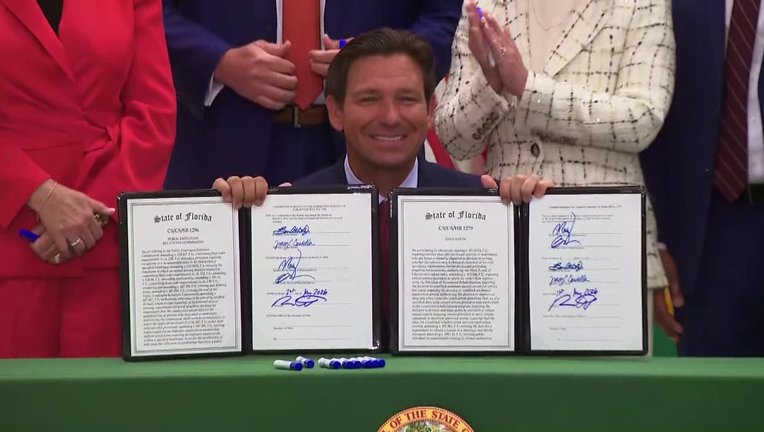
FORT MYERS, Fla. - Governor Ron DeSantis has officially signed HB 1279 and SB 1296 into law, introducing significant changes to Florida’s education system.
House Bill 1279
HB 1279 spans from prekindergarten regulations to higher education accreditation processes.
Prioritizing Teachers’ Pay
The newly signed bill will increase incentives for teachers, including a $50 bonus for every student who achieves a passing score on an advanced course assessment.
Additionally, teachers that teach advanced courses in "D" or "F" rated schools will receive an additional $500 flat bonus if at least one student passes an advanced assessment.
"Senate bill 1296 and House Bill 1279 will continue Florida's momentum in education. It will serve as a positive step forward to strengthen our education and ensure that we support our educators with true representation," said Florida Commissioner of Education, Anastasios Kamoutas.
School districts can also reserve up to 1% of their Title I funds to provide funds for STEM-related services in certain schools.
K-12 Graduation Requirements
Additional changes were also made to certain academic and graduation requirements.
When it comes to physical education and arts credits, two years of marching band or ROTC now satisfy both one-credit physical education and one-credit performing arts. A dance-related class can also satisfy either requirement.
Higher Education
Public colleges and universities now have up to three years following their reaffirmation review to seek and obtain accreditation from a state-identified accrediting agency.
Furthermore, state university performance-based funding metrics have been expanded to include retention rates, post graduation education rates, and degree production.
The provisions in this act are scheduled to take effect on July 1, 2026.
Senate Bill 1296
Senate Bill 1296 overhauls the rules for public employee unions in Florida.
The main point the bill introduces is a 60% membership threshold. If an established union has less than 60% of its eligible bargaining unit paying dues, the union must formally petition the state for recertification.
If the union fails to petition for recertification within 30 days of renewing its registration, its certification is automatically revoked, and the union can no longer represent those workers.
Additionally, unions can no longer automatically deduct dues from an employee’s paycheck. Rather, employees must now pay their dues directly to the union out of their own pocket.
This comes with one exception: first responders.
First responders, including police officers, firefighters, correctional officers, 911 dispatchers and paramedics are specifically exempt from this rule. Their employer must continue to deduct union dues from their paychecks if authorized. These public safety unions are also exempt from the 60% threshold.
The bill also made it easier to leave a union. Employees can revoke their union membership at any time of the year. If this happens, the union must process the revocation and stop due collections within 30 days.
While striking by public employees is already illegal in Florida, HB 1296 increases the financial penalties.
The maximum fine for a union violating a court injunction is now $30,000, while general fines for each day a strike occurs have doubled to $40,000 per day.
Like the education bill, these new union regulations are scheduled to take effect on July 1, 2026.
The Source: This article was written using information from a press conference with DeSantis and information on House Bill 1279 and Senate Bill 1296.