

UCF scientists create nanoparticle treatment that could reverse radiation damage and restore bone loss

ORLANDO, Fla. - At first glance, it looks like just water in a test tube. But a quick chemical reaction—marked by a color change—signals something extraordinary is happening inside: the creation of trillions of nanoparticles.
Researchers at the University of Central Florida are engineering these microscopic particles using a rare earth metal called cerium. When added to a solution and mixed with an oxidizer, cerium atoms break down into particles so small, you’d need to slice a human hair into 100,000 pieces to match their size.
"Once it’s all done, several trillions of nanoparticles will be there," said Dr. Sudipta Seal, who leads the research alongside Dr. Melanie Coathup.
By controlling temperature, pressure, and chemical conditions, the scientists can even shape the nanoparticles—into rods, spheres, even stars.
From the lab to the body: How nanoparticles become medicine
These nanoparticles are designed to deliver medicine in a safer, more targeted way. UCF researchers have paired the particles with a promising drug called P7C3, originally studied for neurological disorders like Parkinson’s and Alzheimer’s.
The result? A synergistic therapy that appears to:
- Protect medicine as it travels through the body
- Neutralize harmful free radicals
- Stimulate blood vessel growth
- Reduce inflammation
- Trigger bone regeneration
What they're saying:
"The nanoparticles boost blood vessel formation," Dr. Coathup said. "They can also regulate the cells responsible for inflammation."
Early tests show that not only do the particles prevent damage from radiation exposure and bone loss—they may also help reverse it.
Applications on Earth—and beyond
This potential breakthrough could have dramatic implications for:
- Cancer patients undergoing radiation therapy, reducing side effects and speeding recovery.
- Astronauts exposed to harmful cosmic radiation during spaceflight.
- First responders entering nuclear disaster zones like Chernobyl or Fukushima.

"We found that it does work when given as a preventative strategy," said Dr. Coathup. "It works pretty well at preventing the damage, the inflammation, the bone loss that can occur."
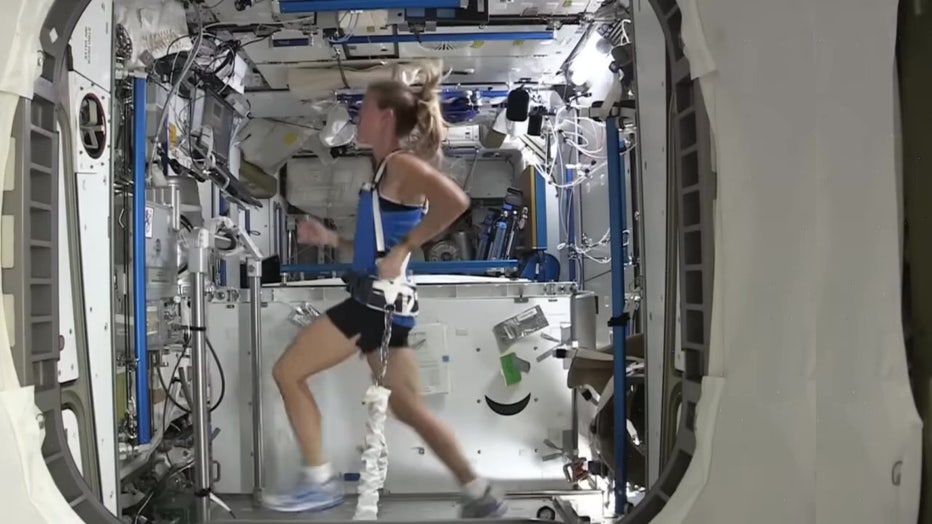
Astronauts on the International Space Station typically lose 1–2% of bone density per month—a rate that severely challenges long-term missions to the Moon or Mars.
With this treatment, UCF’s scientists hope to ease those concerns.
"We have collaborations with NASA," Dr. Coathup added, "and we've been working with colleagues at the Johnson Space Center."
RELATED: Breakthrough in science: UCF chemists develop life-saving wound sealant
What's next:
The team is now preparing for larger-scale experiments, safety testing, and eventually FDA approval. That means building manufacturing capability and continuing partnerships with government agencies.
"It’s a mixture of excitement—cautious excitement—but it’s full of hope," Coathup said.
"If all goes well, we could have a treatment within five to ten years," added Dr. Seal.
They’re planning more tests to confirm their results as they ramp up production.
What you can do:
For an extended look at UCF’s groundbreaking work and visuals from inside the lab, check out the "Breakthroughs in Science" section on the FOX Local app.
The Source: Information for this story was gathered through interviews with Dr. Sudipta Seal and Dr. Melanie Coathup at the University of Central Florida and their written research.