

Blood test could predict what age Alzheimer's symptoms will start, new study suggests

5 healthy lifestyle habits identified as lowering Alzheimer's risk
A combination of physical activity, not smoking, light alcohol consumption, a good diet and cognitive activities may help lower the risk of the disease by as much as 60 percent, a study found.
A blood test could reveal at what age a person will see symptoms of Alzheimer’s disease before they happen, according to a new study.
Researchers at Washington University School of Medicine in St. Louis, Missouri, said this method is cheaper and easier to conduct than other common ways of testing for Alzheimer’s disease.
What they're saying:
"Our work shows the feasibility of using blood tests, which are substantially cheaper and more accessible than brain imaging scans or spinal fluid tests, for predicting the onset of Alzheimer’s symptoms," said senior author Suzanne E. Schindler, MD, Ph.D., an associate professor in the WashU Medicine Department of Neurology.
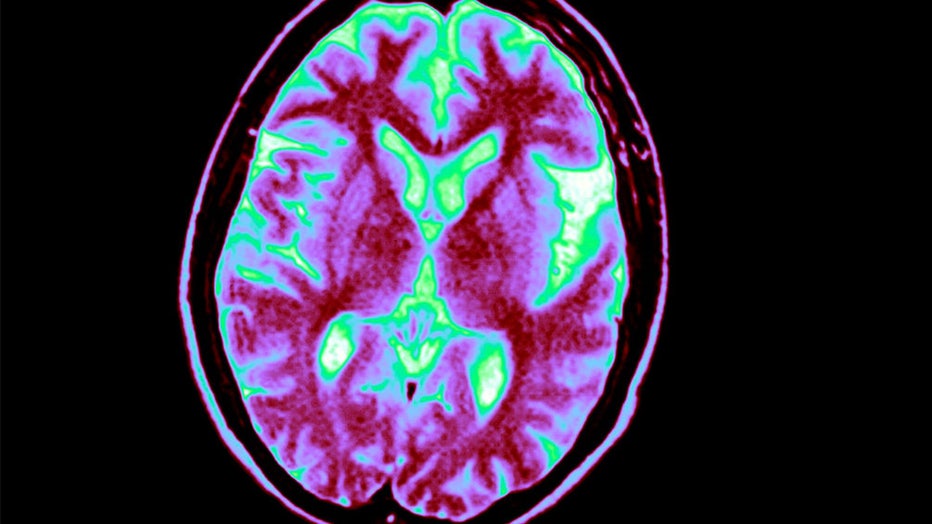
FILE - Voluminous Left Sylvian Fissures. Cortical Sulci And Posterior Horns Of The Lateral Ventricles Are Enlarged. Axial Cut Away View. (Photo By BSIP/UIG Via Getty Images)
Protein p-tau217
The study was part of a larger project which was developed and launched by the Foundation for the National Institutes of Health Biomarkers Consortium.
Dig deeper:
Researchers singled out a protein called p-tau217 and measured elevated levels of this protein and Alzheimer’s symptoms in patients.
The presence of p-tau217 has previously been connected with the accumulation of amyloid and tau in the brain. The elevated presence of amyloid and tau are classic hallmarks of Alzheimer’s disease, according to researchers.
Big picture view:
The models used in this test predicted the onset of symptoms with a margin of error of three to four years.
If a person had elevated levels of p-tau217 in their plasma when they are 60 years old, they could develop symptoms 20 years later, according to this new method.
If the p-tau217 wasn’t elevated until age 80, then they could develop symptoms only 11 years later, researchers said.
What's next:
Authors of the study shared their code of this testing model for other researchers to continue refining it.
"These clock models could make clinical trials more efficient by identifying individuals who are likely to develop symptoms within a certain period of time," lead author Kellen K. Petersen, Ph.D., an instructor in neurology at WashU Medicine said. "With further refinement, these methodologies have the potential to predict symptom onset accurately enough that we could use it in individual clinical care."

Excessive daytime napping could be early indicator of Alzheimer?s disease, study says
Alzheimer?s disease attacks brain regions responsible for wakefulness during the day, the researchers found, adding that wakefulness-promoting neurons in these regions are among the first to be damaged by the disease.
Alzheimer’s in the US
By the numbers:
Over 7 million people in the United States are living with Alzheimer’s, according to the Alzheimer’s Association. That number is expected to increase by nearly 13 million in the next two decades.
What's more, about 1 in 9 people who are 65 and older have Alzheimer’s disease, with two-thirds of cases being diagnosed in women.
Alzheimer’s was the sixth-leading cause of death among people who were 65 and older in 2022 and Americans living with Alzheimer’s at age 70 are twice as likely to die before they reach 80.
The disease warrants more research as people who are diagnosed with Alzheimer’s by 65 will survive an average of four to eight years, but there have also been cases where some live as long as 20 years after diagnosis.
"This reflects the slow, uncertain progression of the disease," according to the Alzheimer’s Association.
The Source: Information for this article was taken from a study published in Nature on Feb. 19, 2026, a news release from WashU Medicine and the Alzheimer’s Association website. This story was reported from San Jose.