

Florida cold front may cause iguanas to fall with the temperatures

Tampa Weather | Forecast
FOX 13's Valerie Mills says Tuesday's forecast calls for cooler temperatures all day with a high of 59 degrees.
TAMPA, Fla. - Look out below! Temperatures across Florida are plummeting and that means the New Year’s ball may not be the only thing dropping this week — Iguanas may tumble out of trees.
The backstory:
On Tuesday, the Florida Fish and Wildlife Conservation Commission posted a reminder about the possibility of falling iguanas on social media as cooler temperatures make their way across the state.
According to FWC, when temperatures fall to near-freezing or below, nonnative green iguanas can temporarily go into a state of torpor, losing all muscle control.
The phenomenon is known as cold-stunning.
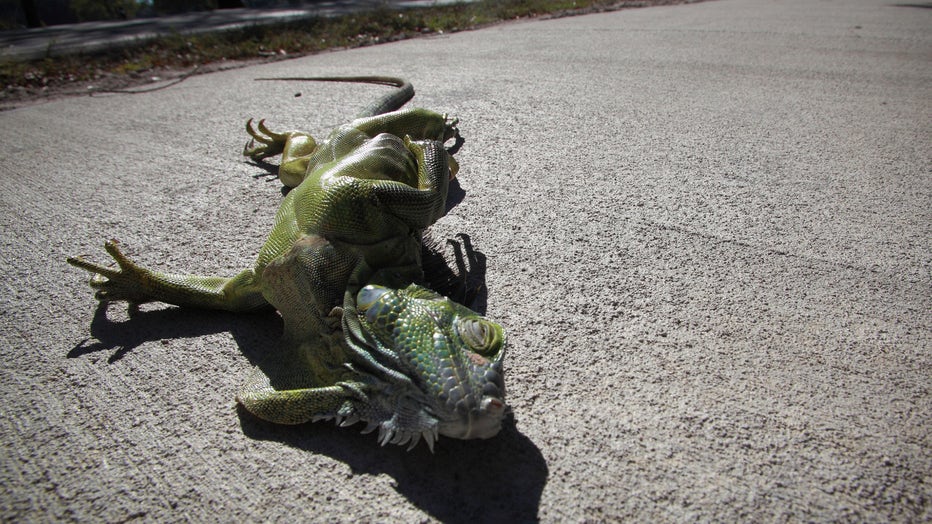
Iguanas typically begin to lose mobility when temperatures reach 50 degrees. Below that, the cold can completely immobilize them. (Cristobal Herrera/South Florida Sun Sentinel/Tribune News Service via Getty Images)
Iguanas rely on the sun to properly regulate their body temperature and as the temperature decreases, the lizards lose their ability to grip trees, causing them to fall.
READ: Cold weather shelters opening across Tampa Bay as temperatures drop
The iguanas aren't usually dead and usually snap out of it after a few hours.
What you can do:
FWC offers these tips for anyone who comes across a cold-stunned iguana:
- Do not bring them inside, whether your house or your car. Iguanas can recover from torpor quickly, much faster than you’d think. Wild iguanas can be defensive when not able to escape, sometimes using their sharp teeth and nails, and long tails that whip.
- Don’t allow pets to interact with iguanas (or other wildlife) – whether cold-stunned or otherwise.
- Don’t relocate or release green iguanas (or any nonnative species – it’s illegal). A permit is required to possess live green iguanas, which are a prohibited species in Florida.
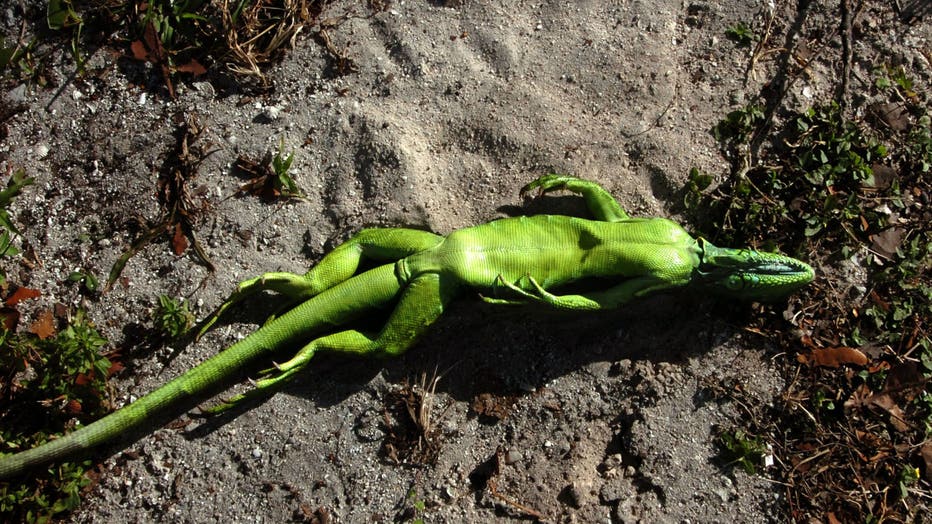
An Iguana lies belly up under a buttonwood tree in Bill Baggs Cape Florida State Park in Key Biscayne, Florida, on January 3, 2008. Temperatures hit the high 20s and low 30s this week in Florida during an unusual cold snap. While many of the iguanas
Iguanas, like all nonnative species, are not protected in Florida, except by anti-cruelty law and can be captured and humanely killed on private property with landowner's permission.
Dig deeper:
Iguanas have existed in the southern part of the state since the 1960s and prefer the tropical climate of South Florida, the Caribbean, and Central and South America. They have caused damage to infrastructure, including seawalls and sidewalks, according to agencies in charge of managing the hundreds of miles of canals that channel water throughout South Florida.
Green iguanas were added to Florida’s prohibited species list in April 2021.
The Source: This article was written with information from the FWC, previous FOX 13 News reports and FOX Weather reports.