

Reviving history: Nonprofit works to restore oysters in Manatee River

PALMETTO, Fla. - The health of the Manatee River has become a main focus of the non-profit, Oyster River Ecology. The organization is working to turn around years of damage done from wastewater spills, construction and overall changes to the area.
With grants and community support, their mission is being seen firsthand.
The backstory:
Oyster River Ecology is working to restore the Manatee River's original namesake. John Lee Williams marked a spot on a map in 1837, a place he called "Oyster River."
"The Manatee River was once called the Oyster River on account of the many, many oysters that used to exist here," Damon Moore, the founder and executive director of Oyster River Ecology, said.
There were so many oysters that according to historical accounts, boats couldn't get in or out of the mouth of the river. Nearly 200 years later, Oyster River is a faint memory, and it's now known as the Manatee River.
What they're saying:
Moore and Abbey Kuhn with Oyster River Ecology are on a mission.
"We are trying to bring oysters back — not at the mouth of the river, we are still going to let boats in and out, obviously. We want that filtration, we want all those habitat values to come back and clean this river up again," Moore said.
Results of their work can be found on just a short boat trip from Parrish.
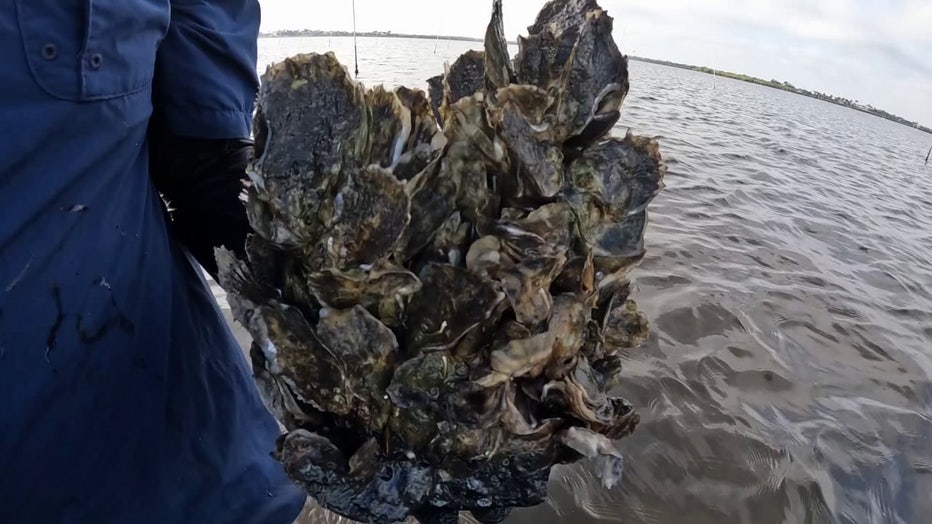
"This is one of them that went into the water in April of last year. Abbey [Kuhn] and I were working by ourselves, we put in about 1,600," Moore said.
It all starts at a warehouse in Palmetto, where volunteers form oyster rag pots. Done by hand and made from a few simple ingredients: A rag, concrete and a wooden spacer with a metal pin.
"It's nice to have other folks in here to kind of keep you on pace and while it is like wash, rinse, repeat, not every batch you mix is the same," Sarah Sheffer, an oyster rag pot fabricator with Oyster River Ecology, said.
Big picture view:
Once the oyster rag pots dry, they're placed in a section of the Manatee River where time begins to work its magic.
"After the oyster rag pot is installed, the larva oysters are kind of free floating in the water with tides, the larva oysters just come and attach to the rag pots. It sort of starts with fingernail oysters. From there, they grow and get bigger and different generations come and attach," Kuhn, the ecological projects coordinator for Oyster River Ecology, said.
Oysters are filter feeders and act as a natural water purifier, which mean they can significantly improve water quality.
Oyster River Ecology is working to fill 10 acres of the river with oyster rag pots. Their goal is to one day restore 100 acres of the Manatee River.
"That’s to match the historical levels. The documented levels from the 1800s, which it’s incredibly important because no one alive today has ever experienced what this river must have been like with 132 acres of oyster reef out there providing that fish habitat. That’s enough oysters to filter the volume of that entire river in two days," Moore said.
Oyster rag pots are filled with life less than eight months after being planted. Underwater footage showed the system is working.
"We see more and more oysters that are big and multi-generational. To see them grow off of each other and form that reef and stay true to their title as an ecosystem engineer. Every time I pull these up, I just smile, and it gives me joy," Moore said.
Moore wants to see the health of the Manatee River restored. It starts with bringing back the oysters, which this river was once named for.
"This is home for me. I grew up fishing in this river. Still have friends who are fishing guides and commercial fishermen who depend on these waterways for their livelihoods. I love our local environment, and I love to be doing something that is having a positive impact on it now, and continue into the future for generations to come, and oysters are one of the best things to do that," Moore said.
What you can do:
If you would like to help assemble oyster rag pots, Oyster River Ecology needs volunteers. They put the oyster rag pots together on Tuesday, Wednesday and Thursdays at their warehouse in Palmetto.
For more information, click here or email damon@oysterriverecology.org or abbey@oysterriverecology.org.
The Source: Information was gathered by FOX 13's Kimberly Kuizon through Oyster River Ecology.